Tools & Methods
I develop practical tools for collecting and analysing ecological data, including:
- HerbiEstim — measure leaf damage automatically from images.
- eDNA sequence representations — use more of the information carried by DNA sequences.
- Field eDNA sampling — simplify filtration and preservation in the field.
1. HerbiEstim
Leaf images → automatic damage estimates
Available now · Open source
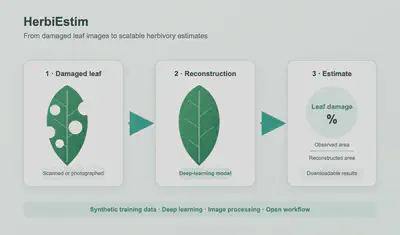
HerbiEstim reconstructs a leaf’s likely original shape and calculates how much area has been lost to herbivores. It is designed for studies with too many leaves for manual measurement.
The online app is the quickest way to try it; the Python code provides a reproducible workflow. The current general model had an average error of about 1.6% in our tests.
Online app · Code · Paper · Training data · Archived release
2. eDNA sequence representations
DNA sequences → three complementary views
R and Python packages in development
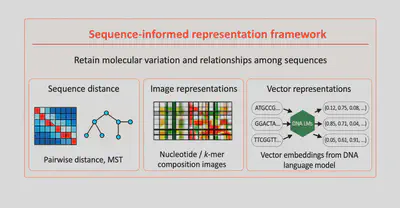
Most eDNA analyses identify sequences and group them into named units. I am developing tools that also retain information in the sequences themselves: their distances from one another, their nucleotide patterns as images, and their numerical representations from DNA language models.
The R package connects these representations with ecological analysis and figures. The Python package handles sequence conversion and machine-learning workflows. The aim is to make datasets easier to compare and more useful for biodiversity monitoring.
Read about the research project
3. Field eDNA sampling
Water sample → capture and preservation
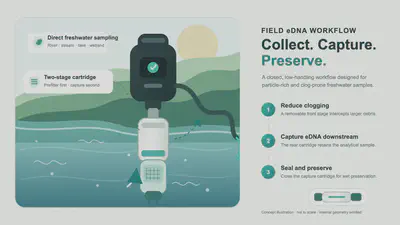
Muddy or particle-rich water can clog eDNA filters, while repeated transfers between filters and tubes increase handling. I am developing a disposable two-stage cartridge: the first stage catches larger debris, and the second captures eDNA and can be sealed for wet preservation.

Zihui Wang
Postdoctoral Fellow
I’m interested in how microbes and insects respond to climate change and amplify climate impacts on ecosystems.