Climate-driven shifts in forest insect and pathogen risks
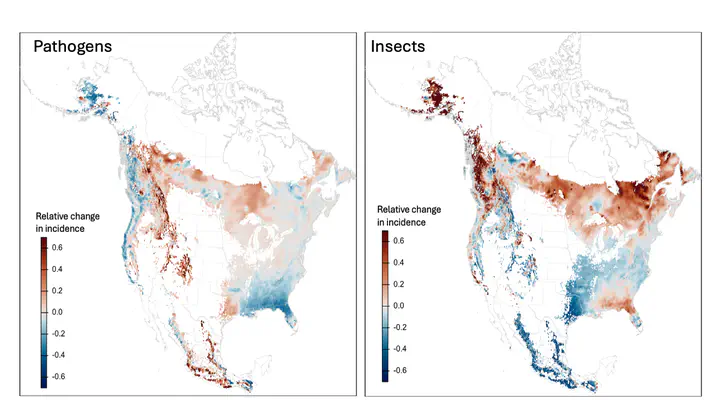
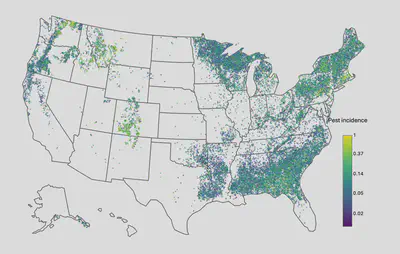
Insect pests and disease outbreaks present significant threats to forest health, ecosystem productivity, carbon sequestration and biodiversity. The impacts of forest pests are exacerbated by climate change; however, variability in climate impacts and non-linearities in species’ responses challenge our ability to make robust forecasts.
Using hierarchical Bayesian models of insect and pathogen incidence recorded on more than one million trees across North America, we show that climate effects depend on historical climate context. Warming and drought increase incidence in historically colder and wetter regions, while incidence can decline in warmer and drier regions. These responses also vary among insect and pathogen groups and host tree species.
Under the SSP2-4.5 climate scenario, our projections indicate that insect incidence will increase across 58% of forest land and pathogen incidence across 52%, with the largest increases at high latitudes. By accounting for variation across climate histories, host traits and pest taxa, this work provides a spatially explicit assessment of future risks to North American forests.

Zihui Wang
Postdoctoral Fellow
I’m interested in how microbes and insects respond to climate change and amplify climate impacts on ecosystems.